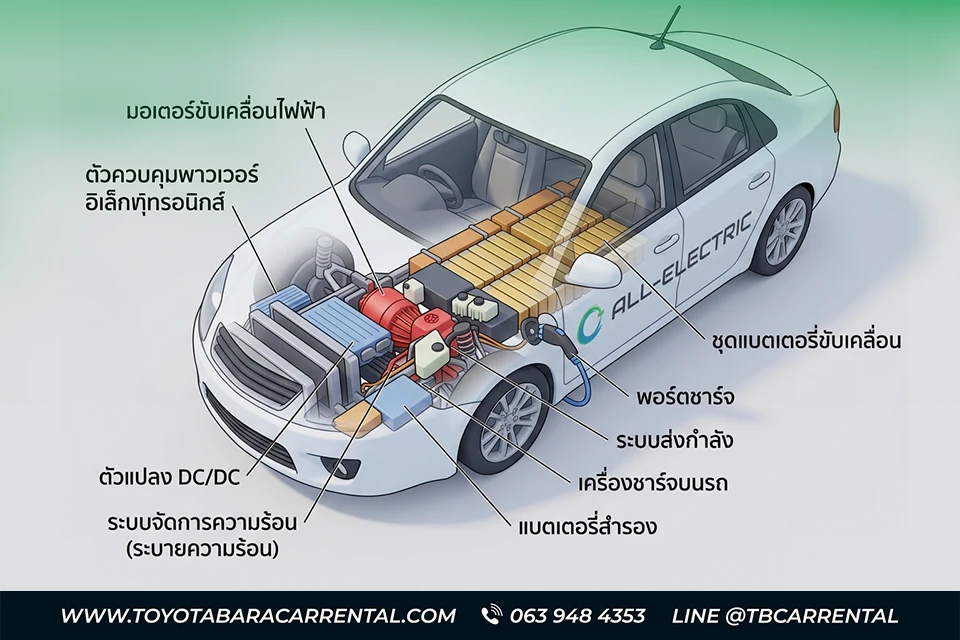
Battery Electric Vehicles (BEVs) are transforming the way we think about driving. Whether you're curious about the technology or seriously considering going electric, understanding how these cars actually work can help you make a smarter, more informed decision.
What Is a Battery Electric Vehicle?
A battery electric vehicle runs entirely on electricity — there's no internal combustion engine, no fuel tank, and no exhaust pipe. Instead, a large high-voltage battery pack stores electrical energy that powers one or more electric motors, which in turn drive the wheels.
To "refuel," you simply plug the car into a charging outlet or Electric Vehicle Supply Equipment (EVSE) — either at home or at a public charging station.
Key Components of a Battery Electric Vehicle
1. Drive Battery Pack
The heart of every EV. This high-capacity lithium-ion battery stores the electrical energy needed to power the motor. A larger battery generally means more range per charge.
2. Electric Drive Motor
Converts electrical energy from the battery into instant torque that drives the wheels. Many EVs use multiple motors for all-wheel drive or enhanced performance. Unlike combustion engines, electric motors deliver maximum torque from zero RPM — which is why EVs feel so responsive off the line.
3. Power Electronics Controller
Manages the flow of electrical energy from the battery to the motor. It controls motor speed and torque output based on driver input — essentially acting as the "brain" between stored energy and motion.
4. Onboard Charger
Converts incoming alternating current (AC) from the charge port into direct current (DC) to charge the drive battery. It also continuously monitors battery characteristics — voltage, temperature, and state of charge — to protect battery health.
5. DC/DC Converter
Steps down the high voltage from the main battery to the lower voltage needed to power vehicle accessories (lighting, infotainment, climate systems) and to charge the 12V auxiliary battery.
6. Thermal Management System
Keeps the battery, motor, and electronics within their ideal operating temperature ranges. Effective thermal management directly impacts battery longevity, charging speed, and overall performance.
7. Charge Port
The connection point between the vehicle and an external power source. Depending on the car and charger type, charging can range from a slow overnight top-up to a rapid DC fast charge at a public station.
8. Electric Transmission
Transfers mechanical power from the motor to the wheels. Most EVs use a single-speed transmission because electric motors can efficiently deliver power across a wide RPM range without needing multiple gear ratios.
How EVs Compare to Conventional Vehicles
| Feature | Battery Electric Vehicle | Petrol/Diesel Car |
|---|---|---|
| Energy Source | Electricity | Fossil Fuel |
| Tailpipe Emissions | None | Yes |
| Maintenance Costs | Lower | Higher |
| Noise Level | Very Quiet | Engine Noise |
| Acceleration Feel | Instant Torque | Gradual |
Want to Experience an EV Before You Commit?
If you're intrigued by electric vehicles but not quite ready to buy, car rental is one of the smartest ways to test the waters. A short-term car rental lets you experience EV driving on real roads — daily commutes, highway runs, city traffic — before making a significant financial commitment. It's a low-risk, practical way to decide whether electric mobility suits your lifestyle.
Final Thoughts
Battery electric vehicles work on a beautifully simple principle: store electricity, convert it to motion, repeat. No combustion, no fuel lines, no exhaust. As battery technology improves and charging infrastructure expands, EVs are increasingly becoming the practical, economical, and environmentally responsible choice for modern drivers.
The future of driving is electric — and understanding how it works is the first step toward being part of it.
Source: U.S. Department of Energy – Alternative Fuels Data Center